Written by: Avery Buker
⏳5 minutes of your time could win you a $50 gift card! 🎉Help us design our new adaptive apparel launch by sharing your experience. 👕 Link Here 👈
Introduction
Braille and accessible typography are reshaping skincare packaging, turning labels into tools for inclusion instead of barriers. This shift might be subtle on store shelves, but it's genuinely transformative for people with low or no vision.
The Atkinson Hyper-legible Font and Why It Matters For Low Vision Users
Let's be honest, most beauty labels are designed for aesthetics first and readability second. Those delicate serifs, ultra-light weights, and tiny point sizes? They might look luxurious, but they're incredibly difficult or outright impossible to read for people with low vision. Atkinson Hyper-legible was created to flip that priority entirely: clarity comes first, and style follows naturally.
Developed by the Braille Institute in collaboration with a design studio, Atkinson Hyper-legible is a sans serif font specifically tailored for readers with partial sight. Instead of aiming for that uniform, sleek look most fonts strive for, it emphasizes difference. For example, letters that get commonly confused are, "l", and "1", or "O" and "0". Being deliberately drawn in clearly distinct ways; open shapes, shapes, generous spacing, and strong, simple forms make each character stand out on its own.
Why does this matter so much for skincare packaging? Well, consider the reality of how these labels actually exist in today's world. They're often printed incredibly small to squeeze in those long ingredient lists. They're stuck on curved bottles or flexible tubes making it more difficult to read. Alongside typically being shiny and or reflective. With all of these factors, overall legibility is reduced and minimal at best.
A font like Atkinson Hyper-legible helps cut through all those challenges. Its clarity means that even when text is scaled down or viewed at an awkward angle, it remains far easier to parse than most standard brand fonts. For people with low vision, that's not solely convenient, it can be the difference between guessing what a product is and reading it independently.
Here's what I find particularly interesting: this kind of type design supports universal usability. Clearer letterforms help everyone who's reading in a rush, scanning shelves from across the aisle, or glancing at a label without their glasses on. Just as ramps help both wheelchair users and parents with strollers, hyper-legible fonts improve the experience for all shoppers, not only those with visual impairments.
And for brands worried about their visual identity? Adopting accessible typefaces doesn't mean sacrificing distinctiveness. Typography can absolutely be both accessible and memorable. The real design challenge and opportunity is building a recognizable brand system around legible fonts, generous spacing, and sensible hierarchy, instead of relying on thin or ornamental type that inadvertently excludes part of your audience.
Understanding Braille Integration In Beauty Product Labeling
While hyper-legible fonts serve people with some usable vision, Braille is essential for those who can't rely on print at all. Yet for years, Braille on beauty products has been disappointingly rare. When it does appear, it's usually on a small subset of items, marketed as some kind of special feature rather than a baseline expectation.
Adding Braille to packaging is admittedly more complex than just putting raised dots anywhere on a bottle. Designers need to consider several factors: the correct Braille code for the language and region, the size and spacing of the dots, and whether the embossing will hold up through regular use and handling. On small products like eye creams, serums, and lip balms, space is already at a premium, and Braille needs to be carefully placed so it's readable without covering up legally required information.
The good news? Some brands have started treating these constraints as a design brief rather than a roadblock. Larger jars and bottles can carry the product's name or main function in Braille"cleanser," "toner," "SPF 30"to help people distinguish items that might otherwise feel identical in their hand. When space is tight, Braille can appear on the side of the box, on a label strip, or on a wraparound band that stays with the product.
There's also growing interest in combining traditional Braille with other tactile cues that work for a broader group of users:
-
Unique textures on caps or bands to differentiate product categories
-
Simple raised icons, like a sun for daytime products or a moon for nighttime use
-
Distinctive patterns for different steps in a routine cleanse, treat, moisturize, protect
While these tactile signals don't replace Braille for users who need precise information, they make quick identification easier for many people, including those who don't read Braille but use touch as an additional navigation tool.
When brands adopt Braille labeling, they're sending a message that goes deeper than "we have accessible packaging." They're acknowledging that blind and visually impaired customers are part of their core audience, not an afterthought. That recognition matters immensely, especially in a category as intimate and personal as skincare.

June Adaptive Restore Yourself- Gender Neutral Crewneck Sweatshirt
High-contrast colour coding for quick product identification
Color is already everywhere in beauty branding, but it's often used in ways that prioritize mood over function. For truly inclusive design, colour and contrast need to do more; they should help people quickly and confidently identify what they're holding.
High-contrast colour schemes make text and key graphic elements pop against the background. Dark lettering on a light surface, or vice versa, is far more readable than low-contrast combinations like pale grey on white or metallic gold on beige. And yes, those are pairings you see constantly in premium skincare. For people with low vision or certain types of colour blindness, low contrast can render a label practically invisible, even when the font itself is perfectly clear.
Beyond just text contrast, brands can use thoughtful colour coding across a product line to create an intuitive system that works at a glance. Imagine a brand that assigns one bold colour family to cleansers, another to exfoliators or active treatments, a third to moisturizers and barrier-support products, and a distinct accent for SPF products.
When each category has a clear colour association, it becomes much easier to distinguish products on a crowded shelf or in your bathroom cabinet. Even if someone can't read the text easily, the colour and shape of the container can guide them to exactly what they need.
The tricky part? Not all colour contrast is created equal. Designers need to test how their palettes actually look for people with different visual profiles; including reduced contrast sensitivity and various forms of colour blindness. It's not enough to assume a colour combination "looks fine" on a high-resolution monitor. It needs to remain readable when printed, viewed in dim lighting, or seen through slightly blurred vision.
The encouraging news is that accessible colour design often enhances premium appeal rather than diminishing it. Clear contrast, disciplined palettes, and logical colour systems can make a brand feel more confident and cohesive. When accessibility and aesthetics work together, a label becomes both beautiful and genuinely usable.
Qr codes and audio descriptions on skincare packaging
Physical labels will always have their limits; the surface area is finite, and regulations require certain information to appear in print. But digital tools can extend accessibility far beyond what physically fits on a bottle.
QR codes, NFC tags, or similar scannable elements give brands a direct bridge between packaging and rich digital content. For visually impaired customers, one of the most powerful uses is audio. A quick scan with a smartphone can provide a short audio summary of the product's purpose, skin type suitability, and main benefits, along with step-by-step spoken instructions for use and clear warnings about active ingredients and potential interactions.
Unlike printed text, audio content can be offered in multiple languages, adjusted for playback speed, and updated over time if formulations or regulations change. It also lets brands provide way more detail than could ever be reasonably printed in legible type on a small label.
These digital layers benefit far more than just people with visual impairments. They help anyone who prefers listening to reading, anyone struggling with tiny print, or anyone who wants to double-check instructions after recycling the box. For complex routines, audio guidance can walk users through the order of products, timing between steps, and what to combine or avoid.
To be genuinely inclusive, though, this digital content needs to follow accessibility best practices too. That means designing web pages that work with screen readers, providing transcripts or text versions alongside audio, and ensuring navigation is simple with clear headings and logical structure.
When done well, the combination of a scannable code on the package and accessible digital content creates a hybrid experience: tactile and visual cues on the physical product, plus rich spoken or screen-readable information online. Together, they make skincare routines easier, safer, and more independent for a wide range of users.
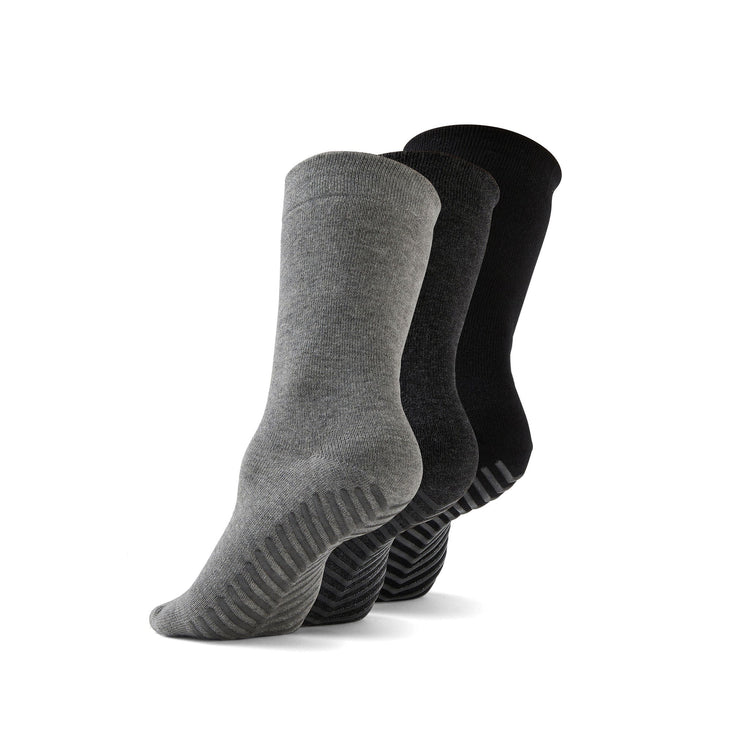
Everyday Crew Anti-Slip Socks 3 Pack
Advocating for better labeling: what consumers can demand from brands
Inclusive packaging in skincare is still far from universal. Many brands are experimenting with isolated features, showing up, one line with Braille here, a limited QR trial there, but the industry hasn't adopted accessibility as a default standard. This is where your voice as a consumer becomes crucial.
You can influence brands in several concrete ways. Start by directly asking about accessibility features through customer service emails, social media messages, or product reviews. Questions like "Do you plan to add Braille or tactile indicators?" or "Will you offer audio descriptions for people who can't read your labels?" send a clear signal that accessibility isn't some niche concern.
Another powerful approach is actively supporting brands that get it right. When companies invest in accessible design through hyper-eligible text, Braille, high-contrast systems, or digital audio content you can highlight and reward those efforts. Share their posts, leave positive feedback, or choose their products over less inclusive alternatives. That tells companies accessibility can be a real differentiator, not just a cost center.
You can also encourage brands to involve visually impaired people directly in their design process. Rather than guessing what might help, companies should collaborate with the people who rely on these features every single day. That might mean testing prototype labels with blind and low-vision panels, working with accessibility consultants, or partnering with organizations focused on vision loss. Labels designed with the community are far more likely to be genuinely practical and respectful.
Finally, push for transparency and consistency. Instead of one-off campaigns, ask brands to share clear commitments, for example; timelines for rolling out accessible packaging across product lines, specific criteria for colour and contrast, or standards for digital content. When these goals are made public, it becomes much easier for everyone to track progress and hold companies accountable.
Skincare is about care by definition. When labels are designed so that more people can read, feel, and hear what they're applying to their skin, that care becomes tangible. The future of beauty packaging isn't just about clean lines and luxe finishes, it's about giving every person, regardless of vision, the information and independence they deserve.
If you enjoyed this blog, please sign up to the June Adaptive Newsletter below to receive more updates!
Share your experience in our 5-minute survey to inform our new adaptive apparel launch. Get a chance to win a $50 gift card Link here