Written by: Hannah Martin
⏳5 minutes of your time could win you a $50 gift card! 🎉Help us design our new adaptive apparel launch by sharing your experience. 👕 Link Here 👈
Introduction
Beauty tools may look simple, but what we don’t see is the sophisticated engineering underneath those polished surfaces. Material science, ergonomics, and user-centered design come together to create tools that don't just work, but also empower. Today's products aren't just about looking good; they're about making beauty accessible to every hand, regardless of strength, dexterity, or ability.

Choose Balance Gender Neutral Sweatpants
Material science in grip design: elastomer vs. rubber vs. matte finishes
Before you even apply a product, the grip creates the first impression. How it feels (maybe it’s soft, tacky, firm, or powdery) can make or break your confidence and control. From a materials science perspective, three surface finishes dominate ergonomic beauty design: elastomer coatings, traditional rubber, and matte-textured plastics.
-
Elastomer coatings strike a balance between flexibility and grip. Made from polymers that blend rubber's resilience with plastic's stability, elastomers absorb subtle pressure changes and flex with your hand. This creates a surface that feels responsive, accommodating both a gentle pinch and a firmer grasp. For people with limited hand strength or conditions like arthritis, that flexibility can mean the difference between a steady stroke and a dropped tool (see how important the material choice is!)
-
Rubber grips (typically silicone or thermoplastic rubber) offer a more tactile, high-friction feel. They excel at preventing slippage, even when hands are wet or oily from lotions or makeup residue. You'll find rubberized handles on high-performance applicators like blending sponges with finger loops or eyeliner pens, where precision depends on maintaining control. The downside? Rubber surfaces can sometimes feel sticky or attract dust, which has led manufacturers to explore cleaner-feeling alternatives like elastomer or hybrid coatings.
-
Matte finishes take a different approach. They're achieved through surface treatment rather than material change. These micro-textured finishes provide subtle grip through fine surface roughness while maintaining a sleek, professional look. They're popular in premium packaging because they add aesthetic sophistication but do not sacrifice functionality. They're also more hygienic, with less porous surfaces making it much easier to clean!
When choosing between these materials, engineers balance three key traits: friction coefficient, tactile comfort, and chemical resistance. Rubber may score highest on friction, but elastomers might perform better under repeated compression or exposure to cosmetics and cleaning products. The best choice ultimately depends on how users interact with the tool, as well as keeping in mind effortless control and comfort.
Shape optimization for different hand sizes and dexterity levels
Material alone can't make a product ergonomic. Shape (more specifically, how it fits the human hand) is equally important. The right contour supports natural hand motion and guides fine motor skills without excess effort. But designing for every possible hand shape or mobility level presents a fascinating challenge.
Traditional applicators often assume average dexterity and grip strength, which excludes a significant portion of users. Engineers now employ anthropometric data. This big word simply means: statistical measurements of human physical dimensions. These are used to develop shapes that align with different hand sizes, joint mobility ranges, and levels of muscle control.
One strategy is scalable geometry: creating handles that vary in girth and taper. A thicker midsection benefits users with larger hands or reduced fine-motor control, offering stability without strain. Slender, lightly contoured tools allow those with smaller hands to maneuver intricate motions, like defining eyebrows or applying eyeliner.
Computer-aided design has also made these refinements far easier. By simulating grip pressure points in digital models, engineers can pinpoint exactly where hands might tire or cramp. Ergonomic mapping visualizes hot spots of muscle strain, guiding subtle tweaks. Even something as little as a smoother angle between handle and applicator or a flattened edge that supports the thumb can be life-changing for so many.
Adjustable and modular systems represent another emerging innovation. Some brands now design interchangeable applicator handles, allowing users to select the grip style that best suits their needs (whether it’s rounded, winged, or angled) and attach their preferred brush or sponge. This approach mirrors the customizable handles seen in adaptive kitchenware or writing tools but applies them to cosmetics with elegance and ease.
Optimizing shape isn't just about accessibility; it's more about comfort for everyone. Just as adjustable chairs benefit all users, an applicator that's easier to hold or less fatiguing to use serves makeup professionals and beginners alike.
Applicator design reducing hand strain and improving precision
Every motion in makeup application involves small, coordinated movements of muscles and joints. If a tool's weight distribution, handle length, or flexibility isn't aligned with natural motion, strain follows. That's why ergonomic applicator design has become central to both professional artistry and accessibility advocacy.
Think about repetitive fine motor movements such as:
- Applying mascara
- Using liquid eyeliner
- Contouring around the cheeks
Over time, these actions can fatigue the forearm and finger tendons, especially when tools are too narrow, too slick, or poorly balanced.
To counter this, engineers consider biomechanics: how torque and force function in hand motion. A brush with a slightly forward-shifted center of gravity allows gravity to assist in downward strokes, reducing the effort needed from finger muscles. Similarly, a soft-touch coating with a vented grip zone can absorb micro-vibrations, minimizing tension transferred to the wrist.
A well-designed applicator doesn't just prevent pain, it enhances precision. Consider the evolution of liquid eyeliner pens. Early designs mimicked markers with straight, smooth barrels. Newer pens feature sculpted, angular grips that naturally position fingers for steadier alignment along the lash line. Some introduce pivoting or flexible tips, enabling smooth, continuous lines with fewer strokes and less wrist movement.
Some beauty tools take innovation even further. Vibration-assisted applicators, often battery-powered, distribute product evenly with minimal manual pressure. This technology helps users with tremors or low hand steadiness achieve professional-quality outcomes without fatigue. Counterbalanced brushes, with subtle internal weights that offset front-heavy mass, reduce the risk of shaking or drops.
These refinements share a common goal: designing motion that aligns with instinctive behavior rather than forcing users to adapt. In today's beauty engineering, effortlessness isn't just marketing talk; it's measurable progress toward universal ease of use.
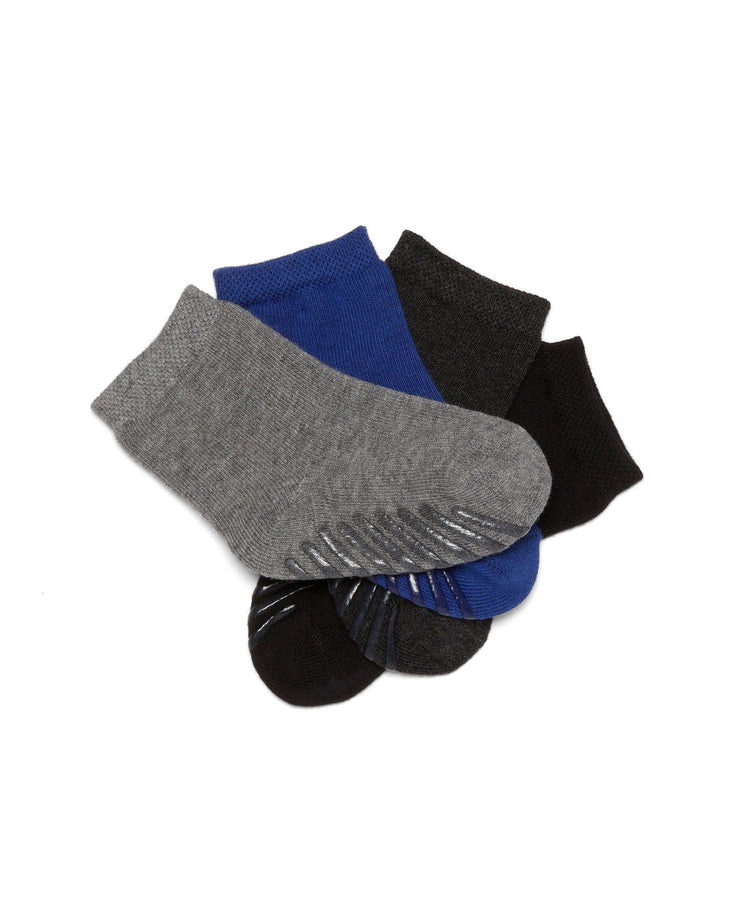
Kid's Blue Multi Anti-Slip Socks 4 Pack
Testing methodologies with people with disabilities
Truly accessible design must be grounded in lived experience. That's why testing beauty tools with people with disabilities goes far beyond compliance; it's about co-creation.
Progressive beauty brands now engage in inclusive usability testing, involving participants with diverse physical abilities from the earliest stages of concept design. Instead of relying solely on ergonomic theory or lab data, these teams gather real human feedback on how applicators feel in motion, how packaging opens, and whether any design aspect discourages participation.
Testing typically unfolds in three phases.
- First, Exploratory workshops serve as co-design sessions where participants share makeup challenges (such as difficulties holding a slim brush or opening twist caps) and demonstrate adaptive techniques they already use. These insights inform early sketches and prototypes.
- Next come prototype trials, where participants test 3D-printed or soft-modeled handles under realistic conditions. Engineers track hand positions, grip pressure, and usability feedback while observing nonverbal cues like shifts in posture or expression that may signal fatigue or frustration.
- Finally, redesign and re-testing are what actually lead to adjustments: features such as a wider base, revised texture, or moving the placement of opening mechanisms. The goal isn't perfection in one round but progress over multiple refinements!
Sometimes, these collaborative efforts lead to innovations that benefit everyone. For example, a mascara designed for users with limited grip strength might feature a click-to-lock wand system, eliminating twisting motions. This same design makes the application faster and easier for any user juggling time and convenience.
Ethically, inclusive testing also respects dignity and independence. Participants aren't test subjects, they're co-creators shaping products that reflect their autonomy. The best outcomes emerge when brands view accessibility as part of beauty's emotional experience: empowerment through design.
How texture and form improve user experience universally
If accessibility brings inclusivity to design, texture and form bring personality and sensory delight. Beyond mere function, these elements influence emotional and cognitive response. This can show up as a feeling of control, satisfaction, or beauty in the process itself.
Texture plays a dual role in both feedback and identity. When fingers run across a soft-touch matte or patterned ridge, they register position and motion through subtle sensory cues. A textured surface reduces the need for visual confirmation, which can be an advantage for visually impaired users, but it also enhances general usability by refining muscle memory. The brain learns; this ridge aligns my hand correctly, reinforcing precision through touch.
Form artfully guides grip behavior. A gentle taper toward the tip encourages the same balanced posture that artists maintain when handling brushes or pencils. Rounded geometry eases transitions between sweeping and dabbing motions, reducing the likelihood of harsh lines or uneven blending.
One of the biggest insights in modern design psychology is universal usefulness through sensory inclusivity. People vary in how strongly they rely on vision, touch, or proprioception (the body's sense of motion and position). When products stimulate multiple senses through visual shape, tactile contour, and even slight temperature contrast between materials, they create more intuitive control for everyone.
Sustainability factors in here, too. Eco-conscious brands are exploring bio-based or recycled elastomers and textured biodegradable plastics that maintain high grip quality while reducing environmental impact. This marriage of tactile innovation and eco-engineering demonstrates how the beauty industry's future merges responsibility with elegance.
Finally, form and texture extend beyond the hand. Visual design communicates accessibility as a core brand identity. A handle that's easy to hold looks reassuring; the soft curves and accessible geometry send a clear message: This product welcomes you. That visual empathy builds trust, connecting innovation with emotional resonance.
As artificial intelligence and sensor technology advance, beauty tools are becoming smarter, even using features such as integrating motion tracking, pressure sensitivity, and adaptive feedback. Next-generation applicators might subtly adjust resistance based on grip strength or pair with apps that offer optimized techniques for different dexterity levels.
Yet even as technology grows more complex, the heart of ergonomic design remains human simplicity. It's about recognizing that beauty rituals, at their best, are moments of care and self-expression, not frustration or limitation.
The engineering behind accessible grips and applicators may start with polymer science or torque equations, but it ends with joy. More specifically, the joy of holding something that feels made just for you!

Good Vibes Only Gender Neutral Crewneck Sweatshirt
If you enjoyed this blog, please sign up to the June Adaptive Newsletter below to receive more updates!
Share your experience in our 5-minute survey to inform our new adaptive apparel launch. Get a chance to win a $50 gift card Link here