Written by: Hamza
Introduction
Minimalist packaging is having a moment. Clean labels, lots of white space, muted colour palettes, it looks gorgeous on Instagram and screams "premium" on the shelf. But here's the thing, when minimalism is done purely for aesthetics, it can actually make products harder to use for millions of people.
And we're not talking about a small group. Over 2.2 billion people worldwide live with some form of visual impairment. In the UK alone, one in five people has a disability. Colour blindness affects roughly 4.5% of the population! That's nearly 1 in 20 people who might struggle to tell your beautifully muted sage green apart from your equally beautiful dusty rose.
So the question isn't whether to embrace minimalism. It's whether we're doing it in a way that actually works for everyone, or just for the people who don't need packaging to work hard for them in the first place.
The intersection of minimal aesthetic and functional design
So, let's be honest about where minimalist packaging often goes wrong.
A recent GS1 UK study found that 83% of visually impaired consumers find information on food packaging difficult or impossible to access. The top complaint? Small or hard-to-read text, reported by 56% of respondents. Meanwhile, 73% believe that little thought is given to designing packaging for people without sight.
That's not a minor oversight. That's the majority of an already underserved group saying, "Hey, this isn't working for us."
The problem often comes down to a few predictable patterns: ultra-thin fonts that look elegant but disappear for anyone with less-than-perfect vision, low contrast between text and background because "light gray on white" feels more sophisticated, tiny ingredient lists crammed onto minimalist labels because there wasn't room for both "aesthetic breathing space" and readable type sizes, and icons without text labels that leave people guessing.
Here's the good news though: minimalism done right doesn't just tolerate accessibility, it actively supports it. The core principle of minimalist design is reducing unnecessary elements to let the important stuff shine through. That's exactly what accessibility needs: clear hierarchy, obvious cues, and nothing competing for attention. The goals aren't opposed. They're basically the same goal wearing different outfits.

Women's Wide Non-Slip Adjustable Indoor Slippers
Reducing visual clutter for people with cognitive or visual processing challenges
Research on cognitive load backs this up in a big way. When interfaces or packaging are cluttered with competing elements, everyone struggles to process information, but the impact hits hardest for people with cognitive disabilities, ADHD, or visual processing challenges.
The Nielsen Norman Group, a leading user experience research firm, puts it simply: "Avoid visual clutter: redundant links, irrelevant images, and meaningless typography flourishes slow users down." White space around text blocks improves readability across the board, not just for people with disabilities. Reducing visual noise helps people focus on what actually matters!
For someone with a cognitive processing challenge, a busy package covered in graphics, multiple font styles, and decorative elements isn't just annoying, it can be genuinely overwhelming. The brain has to work overtime to filter out what's irrelevant and find the information that matters, such as ingredients, dosage instructions, or allergen warnings.
Minimalism, when executed thoughtfully, reduces the mental effort required to interact with a product. Fewer elements mean fewer decisions about where to look. Consistent typography means less mental switching between styles. Generous spacing means the eye can move through information without getting lost.
The key distinction is between minimalism that removes helpful cues versus minimalism that removes unhelpful noise. Stripping away a decorative border pattern? Probably fine. Stripping away the contrast between your text and background? Now that’s a problem!.

Imperfectly Perfect - Gender Neutral Crewneck Sweatshirt
Clear labeling standards that don't sacrifice style
So what does accessible minimalism actually look like? It starts with some non-negotiables regarding labeling.
Web accessibility guidelines (WCAG) recommend a contrast ratio of at least 4.5:1 for normal text. That's not arbitrary, it's the standard in which text becomes readable for people with moderate visual impairments. In terms of packaging, this means reconsidering those beautiful light-on-light color combinations. A muted aesthetic can still work, you just need to ensure there's enough difference between your text and background that people can actually read it. Black text on a cream background? Still minimalist. Still readable.
Font size matters too, especially for critical information like ingredients, allergens, and usage instructions. WCAG considers 18pt (about 24px) to be "large text" that's inherently easier to read. That doesn't mean everything needs to be huge, but maybe the ingredient list doesn't need to be in 6pt type just to preserve the minimalist vibe.
Tactile cues offer another elegant solution. Herbal Essences made waves in 2019 when they added simple tactile markers to their bottles, raised stripes on shampoo, and raised circles on conditioner. It's minimal, it's clean, and it helps people with vision impairment (or anyone in a steamy shower without their glasses) tell products apart by touch.
The Royal National Institute of Blind People tested the design with visually impaired consumers, and the response was overwhelmingly positive. P&G's accessibility leader, Sumaira Latif, who is herself blind, lead the initiative after years of putting rubber bands on her own bottles just to tell them apart.
This is minimalism in action. No busy graphics. No complicated instructions. Just a simple physical marker that communicates through touch.
Sustainable minimalism reducing material waste
Here's where minimalism gets even more interesting: the same principles that make packaging more accessible often make it more sustainable too!
Think about what minimalist packaging typically eliminates, excessive ink coverage, multiple material layers, elaborate structural elements, redundant inserts and leaflets. All of that is material that has to be produced, transported, and eventually disposed of. When you strip packaging down to what's actually necessary, you're often reducing environmental impact at the same time.
P&G's Sumaira Latif has pointed out that inclusivity and sustainability goals are deeply interrelated. When companies design packaging, it's "a good opportunity to design packaging that is both good for the environment and for consumers with disabilities."
Gillette's move away from plastic blister packs is a perfect example. The brand shifted to cardboard packaging with a tear strip and minimal glue, making it easier to open for customers of all abilities while simultaneously cutting down on thick plastic waste (how neat!). The new packaging doesn't require scissors or tools, which benefits people with limited hand strength or dexterity while also being more recyclable.
Tide's new evo packaging uses tactile markings for accessibility and a paper-based design for sustainability. The tear strip has a large grip area for easy opening, and the click-closed function provides both tactile and auditory feedback, supporting consumers who are deaf, hard of hearing, or visually impaired, all while using fewer materials than traditional detergent bottles.
The overlap makes sense when you think about it. Accessible design asks: what do people actually need from this packaging? Sustainable design asks the same question. Both approaches push back against the tendency to add more, more layers, more features, more material, when what users really want is something that works simply and well.

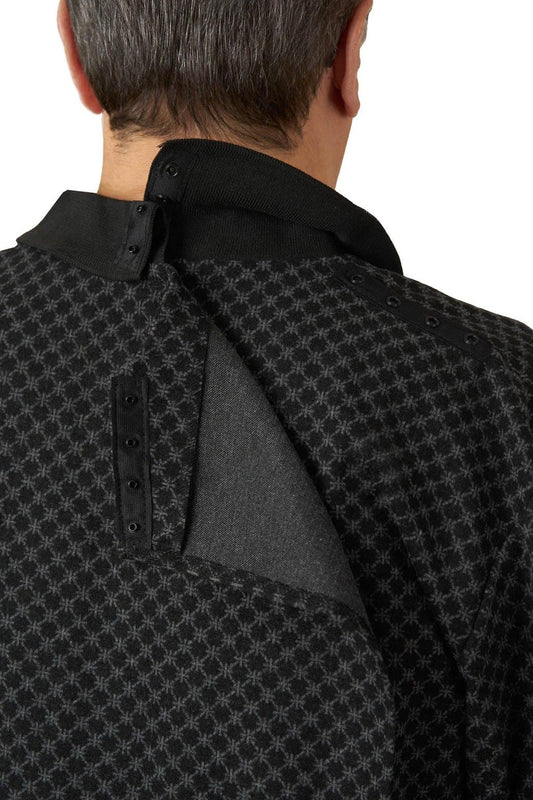
Men's Short Sleeve Button Down Shirt with Back Overlap
Case studies of minimalist brands excelling in accessibility
A few brands are showing what's possible when minimalism and accessibility are treated as partners rather than trade-offs.
Herbal Essences pioneered tactile differentiation in mass-market haircare. Working with the Royal National Institute of Blind People and the Be My Eyes community, they introduced raised stripes for shampoo and circles for conditioner, placed near the bottom of bottles where fingers naturally rest. The brand has since expanded tactile markers across their entire lineup and added Alexa integration and specialized Be My Eyes support for visually impaired consumers to get help identifying and using products.
Unilever's Degree Inclusive deodorant was designed from the ground up with input from individuals with various disabilities. The result includes a hooked container for one-handed use, enhanced grip placement, magnetic click closures that are easier to remove and replace, and Braille labeling. The design is clean and minimal while packing in genuinely useful accessibility features.
OXO built an entire brand on this principle. Their Good Grips line started when founder Sam Farber noticed his wife struggling to use a potato peeler due to arthritis. He designed tools that worked better for her, and realized they worked better for everyone. The brand's packaging follows the same philosophy: clear, uncluttered design that communicates what the product is and how it helps, without unnecessary visual noise.
OLAY Indulgent Moisture Body Wash became the first body wash to include a tactile symbol directly on the bottle. The bottle was also ergonomically designed to be held, opened, and squeezed with minimal effort, with clear artwork that makes it easier to identify and select in stores.
What these brands have in common is that they didn't treat accessibility as a constraint on their design vision. They treated it as a design principle, one that pushed them toward solutions that ended up working better for everyone.
The future looks simpler (in a good way!)
The direction is encouraging. More brands are adopting tactile markers. QR codes that link to audio descriptions or larger-text versions of labels are becoming more common, GS1 UK found that 80% of visually impaired consumers would use QR codes for product information if they were widely available.
Smart packaging technologies are emerging,allowing consumers to scan codes with their phones and have product information read aloud. Partnerships between brands and apps like Be My Eyes are connecting blind users directly with company representatives who can help them navigate products.
And the fundamental insight driving all of this? Accessibility improvements often become universal improvements. The curb cut effect is real: features designed for wheelchair users help parents with strollers, travelers with luggage, and delivery workers with carts. Tactile markers on shampoo bottles help sighted people in low-light conditions or when they're not wearing their glasses.
Minimalism and accessibility aren't competing values. They're complementary ones, both focused on stripping away what doesn't work and keeping what does. The brands that figure this out won't just be doing right by the disability community. They'll be building products that work better for everyone.
And honestly? That's the whole point.
If you enjoyed this blog, please sign up to the June Adaptive Newsletter to receive more updates.
Share your experience in our 5-minute survey to inform our first accessible hygiene line. Get a chance to win a $50 gift card. Link Here”