Written by: Hannah Martin
⏳5 minutes of your time could win you a $50 gift card! 🎉Help us design our new adaptive apparel launch by sharing your experience. 👕 Link Here 👈
Introduction
"Hypoallergenic" sounds reassuring when you're standing in the skincare aisle with sensitive skin. But here's what they don’t tell you: it's way less straightforward than the label suggests. Let's break down what the term means, how to interpret it, and how to protect your skin in practice.
The Regulatory Reality
You'd think "hypoallergenic" means a product is guaranteed not to cause an allergic reaction. That might seem too good to be true… and unfortunately, it is. In most places, the term is loosely regulated and often functions more as a marketing claim than a strict scientific standard.
In the United States, the FDA doesn't have a formal, legally binding definition of "hypoallergenic" for cosmetics. Brands can slap the word on a bottle as long as they're not blatantly misleading…but there's no actual mandatory test or checklist. In reality, "hypoallergenic" usually means the formula was designed to minimize common allergens or irritants, according to that brand's own criteria.
Other regions, such as the EU, scrutinize misleading labels more closely, but even there, "hypoallergenic" isn't a universally standardized certification. It's essentially a promise that the product is less likely to cause a reaction, but it can't.
So when you see "hypoallergenic" on packaging, think of it as one of two things:
-
A signal that the brand tried to remove or reduce certain known irritants
-
Not a guarantee it's safe for everyone with sensitive skin
The key takeaway? "Hypoallergenic" can be helpful, but only as one piece of the puzzle—not the whole story.
What Actually Gets Removed
While there's no single rulebook, hypoallergenic products do share some common strategies. Brands generally avoid ingredients frequently linked with contact dermatitis, irritation, or allergies.
Fragrance (parfum): This is the top trigger for skin reactions. Both synthetic fragrances and natural ones (like essential oils) can cause problems, especially for people with eczema or rosacea. Many hypoallergenic products are labelled "fragrance-free" for this reason.
Certain preservatives: Some preservatives have higher rates of contact allergy, such as formaldehyde-releasing agents (e.g., quaternium-15, DMDM hydantoin) and specific isothiazolinones, such as methylisothiazolinone. Hypoallergenic formulas often use gentler preservative systems while still protecting against bacteria and mold.
Colourants and dyes: Added colour isn't essential in skincare, and some colourants can cause reactions in sensitive individuals. Hypoallergenic products often skip unnecessary dyes, especially in leave-on face products.
Essential oils and plant extracts: Botanical ingredients get marketed as "natural" and therefore "safe," but many are potential irritants. Lavender, citrus, peppermint, and tea tree oils can be problematic for reactive skin. Hypoallergenic formulas typically limit or exclude these.
Harsh cleansing agents: Strong detergents, such as high concentrations of sodium lauryl sulphate, strip the skin barrier and can trigger irritation. Hypoallergenic cleansers use milder surfactants that protect your skin's natural defences.
Known allergens: Chemists consult lists of common contact allergens (compiled from patch-test clinics and dermatology research) when formulating. This helps them avoid specific fragrance molecules, certain lanolin derivatives, or particular sunscreen filters.
Important reminder: "hypoallergenic" doesn't mean free from all possible triggers. It implies the formulator avoided ingredients that commonly cause issues for many people. You can still react to a hypoallergenic product if your skin is uniquely sensitive to something it contains.

Choose Balance Gender Neutral Sweatpants
Decoding the Testing Claims
Skincare labels overflow with reassuring phrases: "dermatologist-tested," "allergy-tested," "clinically proven." They sound scientific, but the reality behind them varies wildly.
"Dermatologist-tested": This usually means a dermatologist was involved in designing or supervising a test, or that a product was evaluated on people under dermatological oversight. It doesn't mean every dermatologist recommends it or that it's safe for every skin type. The testing group might have been small with very limited criteria.
"Allergy-tested" / "Tested for sensitive skin": This can refer to patch tests on volunteers, often including people with sensitive skin or allergy histories. But the details matter: How many people? For how long? What reactions were monitored? Even well-designed studies can't account for everyone's unique sensitivities.
"Clinically tested" / "Clinically proven": These suggest controlled testing with before-and-after measurements (hydration, redness, barrier repair, etc.). However, cosmetic testing is typically shorter and less rigorous than drug trials. Claims might be based on small sample sizes or subjective feedback. "Clinically tested" doesn't automatically equal "effective for you."
The key is that these terms aren't tightly regulated. They can be used honestly, but also very broadly. A product could be "clinically tested" on 20 people for two weeks and still legally use that phrase, even if some participants had mild irritation.
When you see these claims on a hypoallergenic product, take them as a positive sign that some evaluation happened,but not as a guarantee. Real protection comes from understanding your own triggers, reading ingredient lists, and patch testing.
Reading Ingredient Lists Like a Pro
For sensitive skin, getting comfortable with ingredient lists is empowering. You don't need to become a cosmetic chemist, but it is critical to learn a few patterns to quickly decide whether a "hypoallergenic" product is worth trying.
Start with the first 5–10 ingredients: Ingredients are listed in descending order by concentration. The first handful makes up the bulk of the formula. If there's a potential irritant near the top, skip it.
Look for fragrance and essential oils: If you see "fragrance" or "parfum," the product contains added scent, even if it claims to be "mild" or "for sensitive skin." Watch for essential oils (citrus peel oils, lavender, eucalyptus, peppermint) or EU-listed fragrance allergens (limonene, linalool, citronellol). If your skin is reactive, fewer is better.
Scan for your personal triggers: Everyone's different, but examples include:
-
Dry or eczema-prone skin: high levels of drying alcohols (denatured alcohol)
-
Rosacea-prone skin: menthol, strong fragrance, high concentrations of acids
-
Known allergy history: specific preservatives, sunscreen filters, or plant extracts you've reacted to before
Check for barrier-supporting ingredients: Many gentle, sensitive-skin products include ingredients that support your skin barrier: ceramides, cholesterol, fatty alcohols (cetyl or cetearyl alcohol), glycerin, hyaluronic acid, and soothing agents like allantoin or panthenol. These are good signs the formula is barrier-conscious.
Be skeptical of "free-from" claims: "free from parabens" or "free from sulfates" are often more marketing than safety. Some of these ingredients are well-tolerated by many people. What matters is whether you have a reason to avoid them. Don't rely on "free-from" banners but rather cross-check the ingredient list with your own history, better to be safe than sorry!.
If you're very reactive, keep a simple skincare journal. When you try a new product, note the ingredients and how your skin responds over a few weeks. Patterns will emerge, and you may notice that you consistently react to a particular essential oil or preservative. That knowledge is far more powerful than any "hypoallergenic" label; only you know your skin best.
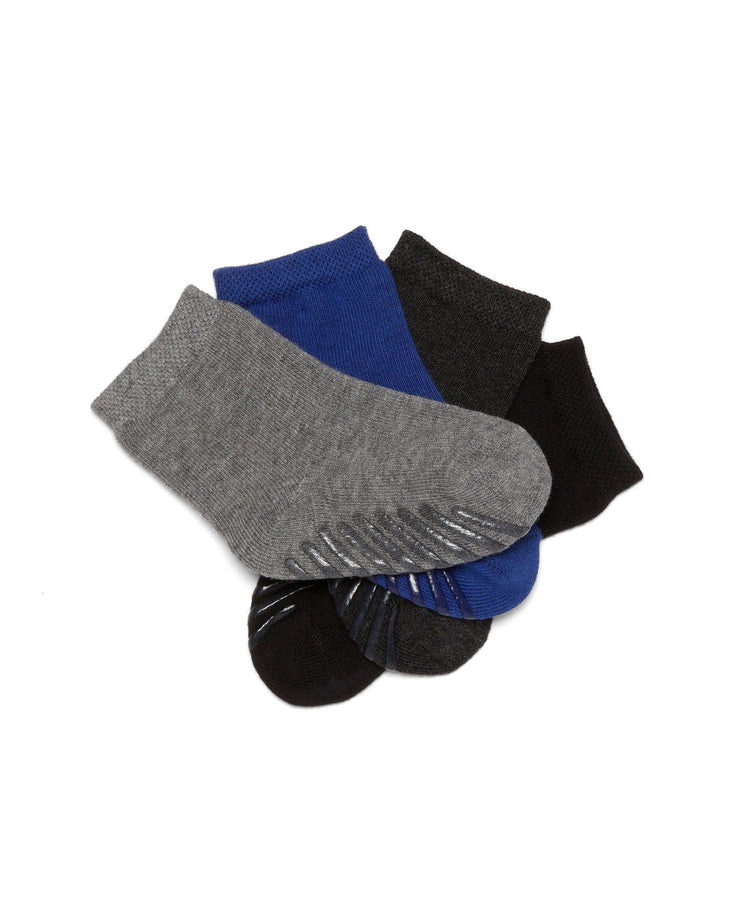
Kid's Blue Multi Anti-Slip Socks 4 Pack
The Power of Patch Testing
Even careful label reading can't fully predict how your skin will react. That's where patch testing comes in: it's a simple way to reduce the risk of a bad reaction, especially if you have sensitive or allergy-prone skin.
Choose a small, discreet area: Common spots include the inner forearm, just behind the ear, or along the jawline for face products. These areas are easy to monitor and usually reflect how your facial skin might respond.
Apply a small amount once daily for several days: Use a pea-sized amount on your chosen patch. Do this once a day for 3–5 days without layering other new products on top. This reveals delayed reactions, not just immediate stinging.
Watch for warning signs:
-
Redness that doesn't fade quickly
-
Itching, burning, or stinging
-
Tiny bumps, hives, or swelling
-
Dry, flaky, or cracked skin
If you notice any of these, gently wash the area and stop using the product. For strong or persistent reactions, consult a dermatologist.
Be extra cautious with potent actives: Ingredients such as retinoids, high-strength acids (AHA/BHA), and high-dose vitamin C can cause irritation, even in people who don't typically identify as sensitive. With these, extend the patch test to a full week and introduce them gradually, such as a few times per week rather than daily.
Consider professional patch testing: If you've had repeated unexplained reactions, a dermatologist or allergist can perform formal patch testing with standardized panels of common cosmetic allergens. This identifies specific substances you should avoid. Once you know your triggers, choosing products becomes much more straightforward.
Patch testing takes time and patience, but it's one of your most reliable tools for protecting sensitive skin. Think of it as a small upfront investment to avoid weeks of redness, burning, or flare-ups.
The Bottom Line
"Hypoallergenic" can be helpful, but it's not a magic shield. It signals a direction,that a formula was designed with fewer common triggers but remember: it is not a promise that it will help everyone with sensitive or reactive skin.
To make "hypoallergenic" work for you:
-
Use it as a starting filter, not a final decision
-
Examine ingredient lists closely, especially the first 5–10 ingredients and any fragrance
-
Treat claims like "dermatologist-tested" as supportive context, not guarantees
-
Make patch testing a habit before committing to new products
Most importantly, trust your own skin more than any label. Over time, you'll learn which textures, ingredients, and brands work for you(and those don't!)regardless of the words on the bottle. That combination of educated skepticism, ingredient awareness, and gentle experimentation is the real foundation of a sensitive-skin-friendly routine.
Your skin knows what it needs. The label is just a starting point.

Good Vibes Only Gender Neutral Crewneck Sweatshirt
If you enjoyed this blog, please sign up to the June Adaptive Newsletter below to receive more updates!
Share your experience in our 5-minute survey to inform our new adaptive apparel launch. Get a chance to win a $50 gift card Link here